DJI Drops a Bomb: Osmo Pocket 4 Pro Officially Launched (And It’s a Massive Leap)
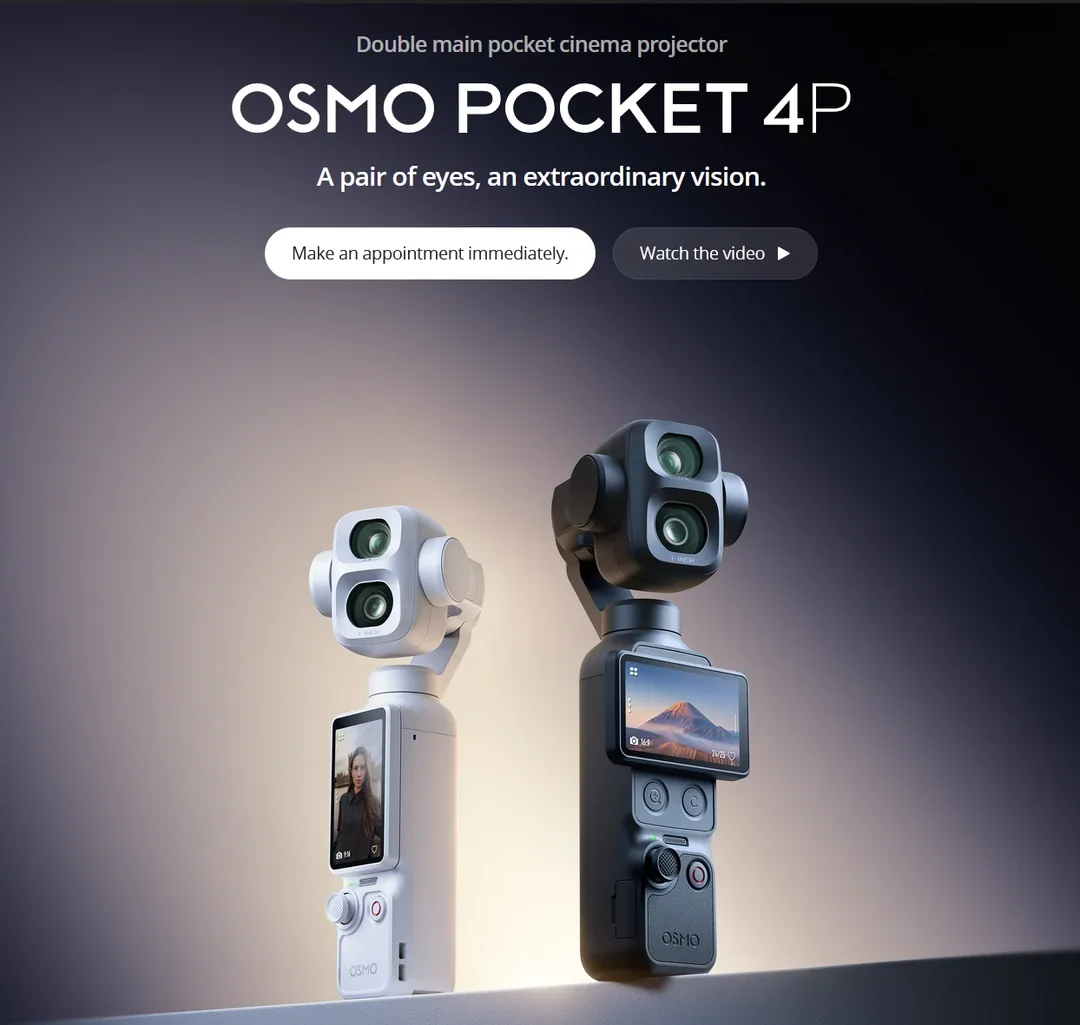
DJI has officially pulled back the curtain on its next-generation compact gimbals in mainland China. The official product pages, spec sheets, and comparison tools are live, giving us concrete, confirmed details.
While a global release date hasn’t been announced just yet, the data paints a crystal-clear picture: DJI is splitting the lineup, and the new "Pro" model is an absolute beast.
Here is everything you need to know about the Osmo Pocket 4 and the groundbreaking Osmo Pocket 4 Pro.
The Quick Take: Which Jump Are We Looking At?
Pocket 3 → Pocket 4: A modest, iterative upgrade. You get better autofocus, improved tracking, and slightly better low-light performance, but it remains a single-lens system without pro-tier features.
Pocket 4 → Pocket 4 Pro: A massive tier jump. The Pro introduces a dual-lens system, a 1-inch LOFIC sensor, 4K/240fps video, D-Log 2, internal storage, blistering fast USB 3.1, Wi-Fi 6, and built-in timecode.
Pocket 3 → Pocket 4 Pro: The largest single-generational leap in the history of the Pocket lineup. It completely redefines what a pocket-sized camera can do.
Under the Hood: Osmo Pocket 4 Pro Core Specs
The Pro model isn't just an incremental refresh; it’s a total overhaul designed for high-end creators and production environments.
1. The Camera System
Dual-Lens Setup: Features a primary 1-inch wide-angle sensor paired with a secondary 1/1.28-inch 60mm f/1.8 mid-telephoto portrait lens.
Insane Frame Rates: Shoot up to 4K at 240fps on the wide lens, and 4K at 200fps on the telephoto.
Pro Color: Full 10-bit D-Log 2 support.
Next-Gen Tracking: Upgraded 3-axis mechanical gimbal running ActiveTrack 8.
“Real Shot” 4K Photos: Combines a pre-shutter video buffer with audio so you never miss a moment.
Stitched Stills: Capable of creating up to massive 3,700-megapixel stitched panoramic images.
2. Storage & I/O
Internal Storage:103GB built-in memory, supplemented by a microSD slot.
Pro Connectivity: Upgraded to USB-C 3.1 Gen 2 (capable of up to 800MB/s wired transfers) and Wi-Fi 6 for blazing-fast wireless offloads.
3. Battery & Power
Hyper-Fast Charging: Juices up to 80% in just 18 minutes.
Extended Life: Offers up to 210 minutes of continuous runtime (tested at 1080p/24).
💡 Bonus Pro Features: Built-in timecode support for multi-camera syncing and a massive new accessory ecosystem (including magnetic ND filters, a soft-light portrait lens, fill lights, and a remote handle).
The Secret Sauce: What is a LOFIC Sensor?
You’re going to hear the word LOFIC a lot. It stands for Low-Noise, High-Dynamic-Range Overflows Integration Capacitor.
This is a physical, hardware-level architecture built into the silicon of the Pro's 1-inch sensor—not an AI software trick or marketing gimmick.
Why LOFIC Matters to Creators:
Zero Blown-Out Skies: It allows the sensor to hold a massive amount of light charge before it "overflows." This prevents highlight clipping in harsh environments (e.g., shooting against bright windows, direct sunlight, or neon lights).
Clean Shadows: Because the sensor captures light so cleanly, you don't have to aggressively boost the shadows in post. Less boosting means vastly less digital noise.
True 17-Stop Dynamic Range: This hardware trick allows DJI to claim a staggering 17 stops of dynamic range when shooting in D-Log 2. While real-world, usable DR will be slightly lower, it will utterly crush the Pocket 3 and standard Pocket 4.
Head-to-Head: Pocket 3 vs. Pocket 4 vs. Pocket 4 Pro
The Lineup At A Glance
Osmo Pocket 3: The Baseline
Camera: Single lens with a standard 1" sensor.
Video & Color: Maxes out at 4K/120fps using the older D-Log M color profile.
Tracking: Runs ActiveTrack 6.0.
Storage & Data: No internal memory (microSD card required) and uses slower USB 2.0 transfer speeds.
Battery Life: Solid ~166 minutes of runtime.
Best For: Everyday content creators who already own it and don't need cinema-level workflows.
Osmo Pocket 4: The Standard Refresh
Camera: Shrunk down to a single 1/1.3" sensor.
Video & Color: Matches the Pocket 3 at 4K/120fps and D-Log M, but offers improved low-light processing.
Tracking: Upgraded to ActiveTrack 7.0.
Storage & Data: Adds 107GB of built-in internal storage, though it keeps the slower USB 2.0 speeds.
Battery Life: Slightly bumped up to ~180 minutes.
Best For: Mainstream users upgrading from much older gear who want built-in convenience without a pro price tag.
Osmo Pocket 4 Pro: The Professional Powerhouse
Camera: Dual-lens system featuring a 1" LOFIC wide-angle sensor and a dedicated 60mm mid-telephoto portrait lens.
Video & Color: Massive jump to 4K/240fps (wide) / 4K/200fps (tele) and professional 10-bit D-Log 2.
Tracking: Next-gen ActiveTrack 8.0.
Storage & Data: Packs 103GB of internal storage paired with ultra-fast USB-C 3.1 Gen 2 (800MB/s) and Wi-Fi 6.
Battery Life: The longest of the bunch at ~210 minutes.
Best For: Commercial filmmakers, hybrid shooters, and power creators who need seamless multi-cam syncing, massive dynamic range, and fast workflows.
The Fine Print: Limitations to Keep in Mind
No camera is perfect, and DJI’s official footnotes reveal a few restrictions you should know before buying:
Framerate Restrictions: 4K/240fps is exclusive to the wide-angle lens. The mid-telephoto lens maxes out at 4K/200fps.
Zoom Limitations: D-Log 2 only supports 1x zoom. Furthermore, certain zoom ranges are completely disabled when shooting in dedicated slow-motion or low-light modes.
Vertical Shooting: Vertical video orientation does not support 4K resolution.
Cable Matters: To get the full 800MB/s transfer speed from the internal storage, you must use a proper USB-C 3.1 Gen 2 rated cable.
Tracking Limits: Intelligent tracking (ActiveTrack 8) will automatically disable itself during certain high-framerate or heavy gimbal movement combinations.
Pricing & Availability
Currently, the lineup has only been priced for mainland China:
Osmo Pocket 4: ¥2,999
Osmo Pocket 4 Pro: ¥3,799
While we wait for official global pricing and release dates, one thing is certain: if you've been holding out on upgrading your Pocket 3, the Pocket 4 Pro looks like it is going to be well worth the wait.