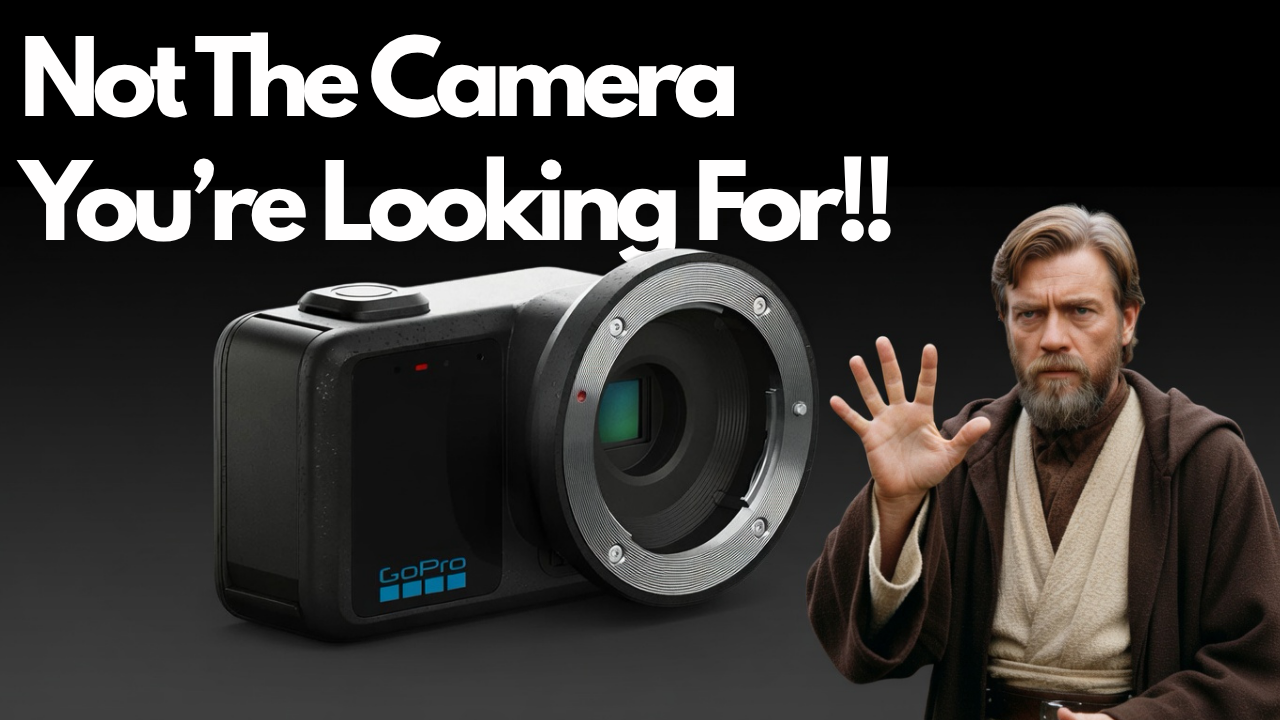
The GoPro Mission 1 Pro ILS is genuinely exciting on paper. An interchangeable MFT lens mount on a rugged, compact, high-speed camera with a 1-inch sensor and HyperSmooth stabilisation — nothing else in the category offers that combination. But there are some real-world limitations to this system that the spec sheet glosses over, and if you're a casual shooter thinking about waiting for the Q3 ILS release, there's a good chance it will not work the way you're imagining.
This is not a takedown of GoPro or the Mission 1 series. It's a practical breakdown of what the ILS actually means in daily use — so you know exactly what you're getting before it shows up at your door.
The cold mount problem — and why it matters
The MFT mount on the Mission 1 Pro ILS is a cold mount. No electronic contacts. That one fact eliminates roughly 95% of the MFT lens ecosystem from the conversation immediately.
What a cold mount means in practice: lenses that rely on electronic communication with the camera body — which is almost all modern MFT lenses — will not function. You cannot change aperture. You cannot change focus, because most modern lenses use focus-by-wire, meaning electronic control. A lens like the Lumix 50mm f/1.7 (the rebranded Leica glass) simply will not work here. It needs the camera's electronics to operate. The same applies to the vast majority of Panasonic, Olympus, and OM System lenses currently on the market.
What does work: fully manual lenses with physical aperture rings and mechanical focus. Vintage glass, Voigtländer primes, and the wave of affordable Chinese manual lenses (7Artisans, TTArtisan, Meike) all mount and function without electronics. These are legitimate, often excellent options — but they represent a fundamentally different shooting style than most people expecting "MFT compatibility" have in mind.
Electronic stabilisation only — the nighttime problem
HyperSmooth works on the ILS, but it is electronic image stabilisation only. There is no in-body optical stabilisation, and because the mount has no electronic contacts, you cannot use any of the stabilised MFT lenses either. For daylight shooting this is manageable. For anything below around 1/100s shutter speed — which is where you will be at night or indoors — EIS alone produces noticeable jitter that neither the camera nor the lens can correct.
The practical workaround for low-light video is a tripod. Handheld nighttime shooting with this system, at the shutter speeds required for clean motion, is going to be a challenge. If low-light handheld video is a primary use case for you, this is worth factoring in heavily before committing to the ILS over the standard Mission 1 Pro.
What you can actually use
Once you accept the manual-only constraint, the options are better than they might initially seem. The 2.7x crop factor means you're shooting in the very centre of whatever glass you mount — which is actually a sharpness advantage, since optical quality degrades toward the edges of most lenses. Expect unusually sharp images across the aperture range as a result.
Worth noting: adapting legacy glass from other mounts — Leica M, M42, Nikon F, Canon EF — only requires a dumb adapter, typically $10–15. These adapters are passive with no electronics, which is exactly what the ILS cold mount needs. The expensive electronic adapters (like the Techart at around $250) are unnecessary here, which keeps costs reasonable.
The focus workflow — be honest with yourself
Manual focus is a skill. It is learnable, and once you understand techniques like trap focus and using a lens's distance markings, it becomes a reliable part of your workflow. But if you have never manually pulled focus before, the ILS is not the place to learn on the fly — especially given the screen size limitations.
The Mission 1 Pro ILS has a 2.59-inch rear screen and a 1.4-inch front screen. The rear screen is 14% larger than the GoPro 13 — but for a camera specifically designed for manual focus operation, it arguably should have been 50% larger. Focus peaking is the primary focus assist tool available, and the quality of that implementation is completely unproven. Given how poorly focus peaking has been executed on the DJI Action 6 — showing almost the entire frame as in-focus at f/2, with no front-screen support and no DLOG M compatibility — this is one of the biggest unknowns on the ILS.
The most practical solution for serious manual focus work will likely be pairing the camera with a phone app. If GoPro builds a solid iOS and Android app with punch-in zoom, histograms, waveforms, and vectorscope, it genuinely changes the usability picture for this camera. The Media Mod's micro-HDMI output (capped at 4K60) is another route for connecting an external monitor — though that adds bulk and fragility. The app route is the cleaner option, and it needs to be good.
The known limitations at a glance
Alternatives worth considering
If the ILS workflow sounds like it might not suit you, it is worth being honest about that before committing. A few alternatives at different price points are worth knowing about.
If you currently own a mirrorless camera and are unsure whether you'd actually enjoy manual focus shooting, try it first. Pick up a cheap manual prime — $50 to $100 gets you something decent — and spend a few sessions with it before making any decisions about the ILS. That experiment will tell you more than any review can.
Who the ILS is actually for
The Mission 1 Pro ILS makes the most sense for shooters who already understand manual focus, want the smallest possible rugged body with MFT glass flexibility, and are working primarily in controlled or tripod situations where EIS limitations don't bite. Cinematographers who already own a collection of manual primes, vintage glass shooters, and advanced creators who want a compact B-camera or POV option with interchangeable optics are the real target here.
For everyone else — casual users, vloggers, run-and-gun creators — the base Mission 1 or Mission 1 Pro is almost certainly the better choice. You get the same 1-inch sensor and GP3 processor, the same image quality potential, without the workflow complexity of a manual-only lens system on a small screen.
The ILS is a bold, genuinely interesting product. GoPro deserves credit for building something that has no direct competitor at this price point. But it is not for everyone, and it is not the plug-and-play MFT camera a lot of people are imagining when they see the mount.