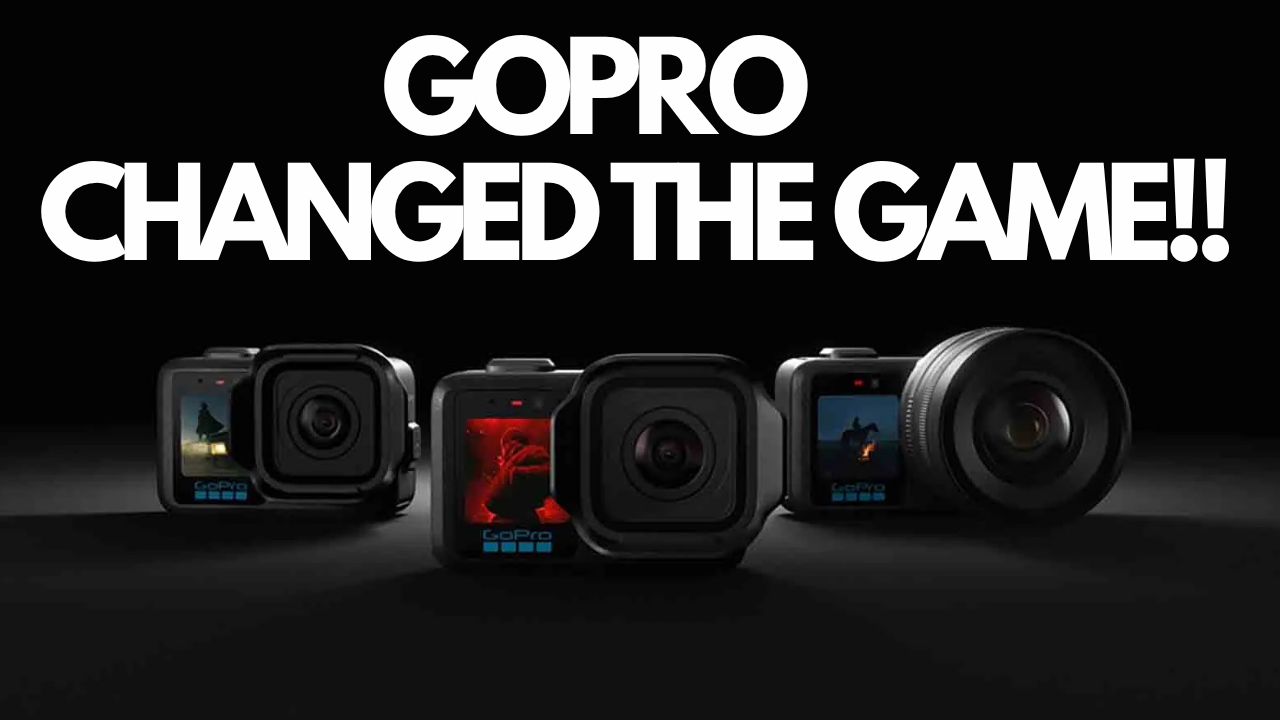
GoPro just killed the HERO line. No HERO 14 is coming. Instead, the company has announced the Mission 1 — a deliberate pivot away from competing with DJI and Insta360 on their own terms, and a direct play for filmmakers, vloggers, and creators who have been asking for a 1-inch sensor action camera for years. Here's everything you need to know.
The big picture
This is not an incremental update. GoPro is openly acknowledging that fighting DJI and Insta360 in the traditional action cam market is a battle it does not intend to win head-to-head. Instead, the Mission 1 series takes a different lane entirely — targeting the filmmaker and vlogger segment with hardware that no direct competitor currently offers at this price point.
The HERO line is over. What replaces it is a camera built around a 1-inch sensor, a 5nm GP3 processor, 32-bit float audio, an interchangeable MFT lens mount option, and a spec sheet that reads more like a compact cinema camera than an action cam. Whether GoPro can actually deliver on all of it is the question — but the ambition is real and the direction is clear.
The three cameras
There are also bundle editions — the Pro Grip Edition, Pro Creator Edition, and Pro Ultimate Creator Edition — for buyers who want accessories included at launch. Pricing across the line has not been confirmed, which is a conversation worth watching closely.
The sensor
The headline spec is the 1-inch sensor — the first time GoPro has ever shipped one. The 50MP count sounds impressive but the number that actually matters for video is the fused pixel mode, which produces a 3.2µm pixel size. That is the spec that drives low-light performance and dynamic range, and GoPro is claiming up to 14 stops. RAW photo support is included, as is burst capture up to 60 photos per second.
For context: the DJI Osmo Pocket 3 — currently the benchmark for lifestyle camera low-light performance — also uses a 1-inch sensor. If GoPro's real-world results hold up to the spec sheet, the Mission 1 will be the first action-oriented camera to genuinely compete with the Pocket 3 on image quality. That is a significant "if" — but it's the right target.
Frame rates — Pro vs base
| Mode | Mission 1 Pro | Mission 1 |
|---|---|---|
| 8K | 8K60, 8K30 Open Gate | 8K30 |
| 4K | 4K240, 4K120 Open Gate | 4K120, 4K120 Open Gate |
| 1080p | 1080p960 burst, 1080p480 | 1080p240 |
| 1440p | 1440p480 | — |
Battery and thermal
GoPro is claiming 5+ hours at 1080p and 3+ hours at 4K30 — substantial numbers for a camera in this class. More importantly, they're claiming most modes run continuously with no thermal shutdown. That last claim is the one that will either make or break trust with pro users, since thermal throttling has been a persistent complaint across the action cam category.
The new Enduro 2 battery runs at 2150mAh with fast charging, and is backwards compatible with the HERO13 Enduro battery — though with shorter runtime. The Volta 2 grip extends battery life up to 9 hours at 4K30, which turns the Mission 1 into a genuinely all-day shooting solution if the thermal claims hold up in the real world.
The GP3 processor
The GP3 is a 5nm chip — a meaningful jump from previous GoPro silicon and the primary reason for the claimed battery and thermal improvements. It includes an AI Neural Processing Unit for low-light video processing and a new advanced encoder designed to keep file sizes manageable without sacrificing quality. GoPro is also unlocking 300Mbps bitrate via GoPro Labs firmware, up from the 240Mbps standard.
Image and colour
GoPro is introducing GP-Log2 as the new colour profile, alongside 10-bit colour and HLG-HDR. There are 13 scene-specific capture modes including Dive Mode and Vlog Mode. Timecode sync for multi-camera shoots is included — a feature that signals clearly who this camera is actually aimed at.
Audio
Four built-in mics with improved stereo and wind noise reduction. 32-bit float audio recording — which means you essentially cannot clip, making it ideal for run-and-gun shooting where you can't monitor levels constantly. Bluetooth 5.3 with Super Wideband Speech for wireless audio.
The new Wireless Mic System is worth calling out separately: 10g magnetic transmitters, 24-bit/48kHz recording, 150m range, 6.5 hour runtime with a charging case, and a Safety Track backup recording. For a first-party wireless mic system, those specs are competitive with standalone options at a similar price point.
Design changes
The Mission 1 ships with a 159° native field of view — the widest in the category. The OLED rear display is 14% larger than previous GoPro flagships. Buttons are taller and chunkier for gloved use, the lens hood is removable, and both the Pro and base model are waterproof to 66ft out of the box, extending to 196ft with housing. The ILS is weatherproof only — it needs housing for any underwater work.
The ILS — what it actually means
The Mission 1 Pro ILS is the most interesting product in the lineup and the one with the most caveats. The MFT mount opens up a massive lens ecosystem — adapters exist for almost any glass you can think of. HyperSmooth works with rectilinear prime lenses, which is a genuine technical achievement.
The limitations: manual focus only at launch (no autofocus), a 2.7x crop factor that makes ultra-wide options tricky, and a weatherproof-only rating. On the other side: there is currently no direct competitor from DJI or Insta360 at this price point for a small, rugged, high-speed MFT cinema camera. That gap is real, and GoPro is walking straight into it.
Accessories
The accessory lineup is extensive and rolls out from May through Q3 2026. The headline pieces: the Media Mod adds 8 mic pickup patterns, three 3.5mm ports, micro-HDMI out up to 4K60, timecode line-in, and headphone monitoring. The Point-and-Shoot Grip converts to a metal cage with cold shoe, 1/4-20, and magnetic mount. The M-Series ND Filter 4-pack (ND8/16/32/64) includes auto-detect shutter adjustment. The Light Mod 2 hits 200 lumens with 33% more battery than the previous version.
GoPro Labs
Over 1,000 custom features and controls are available through GoPro Labs on the Mission 1 series. Given the filmmaker audience this camera is targeting, uptake will likely be higher than it ever was on the HERO line. The 300Mbps bitrate unlock comes through Labs, as will a range of advanced shooting and configuration options for users who want to go deep.
The catch
The bottom line
The Mission 1 is the most interesting thing GoPro has announced in years. Killing the HERO line is a bold call, and the pivot toward filmmakers and vloggers is the right instinct given where the market is heading. The 1-inch sensor, 5nm chip, 32-bit audio, and MFT mount are all features that the creator community has been asking for — and no direct competitor currently offers this combination.
The unknowns are real: unproven processor, first-gen software, no AF on the ILS, and a price that will determine everything. A full hands-on review is the only way to know whether this camera delivers on the spec sheet. But on paper, GoPro has built something genuinely worth paying attention to for the first time in a long while.