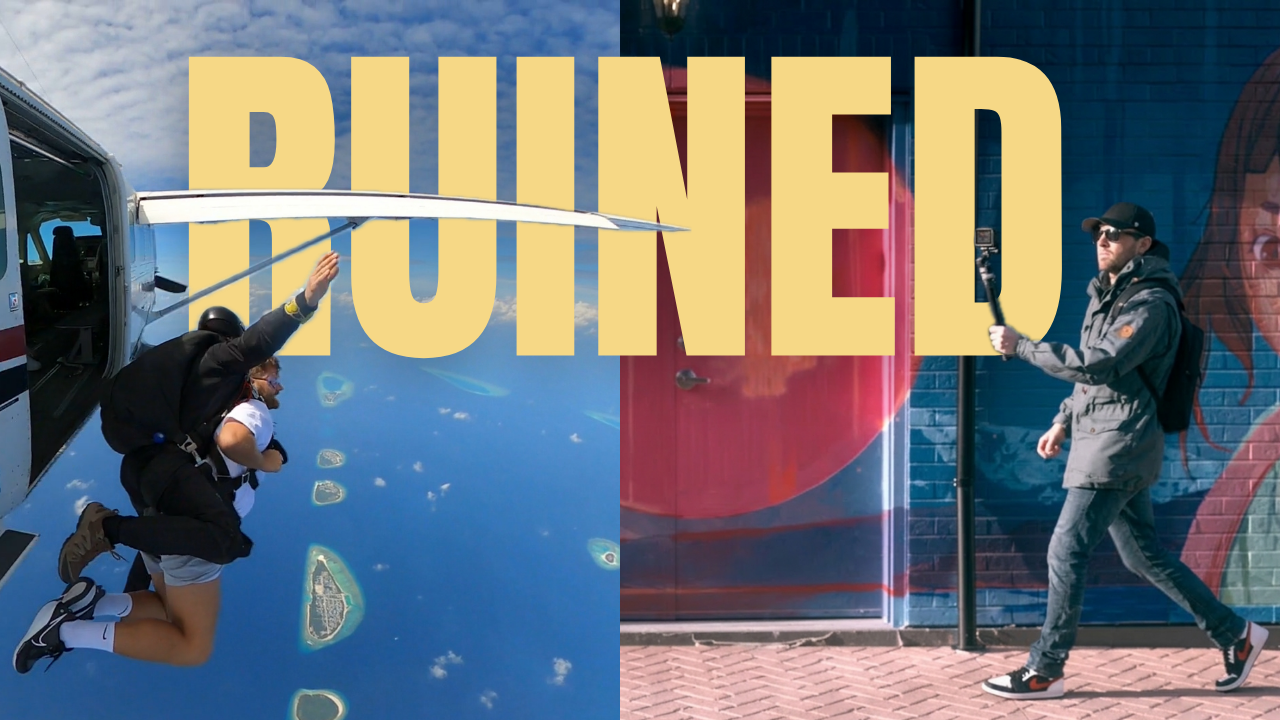
Here's a thought experiment: when did you last strap a camera to your helmet and do something that genuinely put you at risk? If you own an action camera and the honest answer is "never," you're in good company. Industry data suggests that somewhere close to half of the people currently buying action cameras have repurposed them entirely for travel vlogging, casual lifestyle content, and daily documentation — the kind of footage where the biggest danger is forgetting to charge your battery before a morning walk.
That raises a genuinely interesting question: is this shift quietly killing the category that GoPro pioneered, or is it the thing keeping it alive?
A brief history of the rugged little rectangle
The numbers tell the story
By 2026, the global action camera market sits somewhere between $8–9 billion USD, growing at a projected compound annual rate of 11–13% over the next several years. On paper, that sounds healthy. But look at where the growth is actually coming from.
Extreme sports — the original audience — still represent around 40–60% of use cases. Surfing, skiing, mountain biking; anything that genuinely needs a hands-free, weather-sealed point-of-view camera. But the fastest-growing segment is travel, vlogging, and everyday lifestyle content. Some reports put this cohort at 40% of users or more, with roughly half the total user base having shifted toward casual immersive daily capture where an action camera beats a smartphone simply for its convenience and mountability.
Interestingly, extreme sports aren't dying — niche activities like jet skiing and hang gliding have seen 30–56% declines in search interest, but gateway outdoor activity is booming. Hiking, e-biking, and climbing are peaking in the US right now. The audience isn't less adventurous; it's more broadly distributed than early GoPro demos ever suggested.
The Osmo Pocket problem
The clearest expression of this shift isn't an action camera at all. The DJI Osmo Pocket 3, two years old in 2026, continues to dominate lifestyle and vlogging sales in a way that no traditional action cam currently matches. Its 1-inch sensor delivers low-light performance and dynamic range that small-sensor action cameras simply cannot replicate. Its mechanical gimbal, rotatable screen, and active tracking make it purpose-built for exactly the kind of footage most people are actually making: walks, travel, daily documentation, content creation.
It is not built for extreme abuse. You would not mount it to a downhill mountain bike. But for walking-around footage, it produces results that look far closer to a mirrorless system than anything currently wearing a GoPro badge — and that gap matters more than ever to the people making up that growing lifestyle segment.
Insta360 appears to be watching closely. The Luna, announced in February 2026 with a launch expected in the first half of this year, positions itself as a direct Pocket rival: dual lenses, wide plus telephoto, 3× optical zoom, AI bokeh, a modular gimbal design. These are not action camera features. They are cinema-adjacent features aimed squarely at the casual creator.
The sensor wall
Here is where the technical conversation gets interesting. The reason traditional action cameras have not simply added 1-inch sensors and called it a day is physics. A 1-inch sensor measures roughly 13×9mm. Today's action cam sensors run around 9×10mm diagonally. The difference doesn't sound catastrophic until you account for everything that comes with it: bigger optics, meaningfully increased heat output, greater power draw, and a body that would need to grow 20–50% to accommodate all of it — at which point you've compromised the waterproofing, the mountability, and arguably the entire point of the form factor.
This is presumably why GoPro, DJI, and Insta360 have all stayed with smaller sensors to date. Accessories are partly filling the gap — macro lenses, anamorphic adapters, ND filters — effectively expanding the creative ceiling of small-sensor bodies without changing the bodies themselves. It's a pragmatic strategy. But it's also a workaround, and workarounds eventually invite the question of whether a different product category would just be a better answer.
The shareholder problem
None of this happens in a vacuum. GoPro has had genuinely rough years, with revenue declining sharply through 2025 and the company losing meaningful market share to both DJI and Insta360. Shareholder pressure is real and active. The push in a situation like this is almost always toward higher-margin products that can justify premium pricing — which means moving up-market, not defending the mid-range.
GoPro's announcement on March 3rd of their new GP3 processor is significant in this context. It's their first major custom chip upgrade in years, powering not just an expected Hero 14 and Max 3 in Q2 2026, but also a possible dedicated vlogging camera and — notably — an ultra-premium compact cinema-grade device aimed at professional image quality in low light. That last one is not an action camera. It's a product GoPro would have had no plausible reason to build five years ago.
The cynic's reading: brands are following the lifestyle money and the extreme sports camera gets de-emphasized over time. The optimist's reading: a larger, wealthier, more diverse market funds the R&D that eventually makes the rugged action camera better too. Both can be true simultaneously.
So are we killing it?
Probably not — but we are almost certainly changing it. The action camera was born as a single-purpose tool for a specific community. That community still exists and still needs exactly what GoPro was originally built to provide: something that mounts anywhere, survives anything, and captures POV footage hands-free. No pocket gimbal camera replaces that for someone genuinely sending it down a ski slope.
What has changed is the world around that core use case. The market has grown to include millions of people for whom "action" means walking a new city, documenting a bike commute, or filming a weekend trip without wanting to juggle a full mirrorless kit. Those users are not killing the category — they are subsidizing it. And as long as brands can serve both audiences without losing sight of either, the traditional action camera probably has a longer runway than the doomsday headlines suggest.
What's less clear is whether that's actually what's happening in boardrooms right now, or whether the lifestyle pivot is quietly becoming the replacement strategy. We'll have a better sense of the answer when those Hero 14 specs land.